
 (780) 433-0222
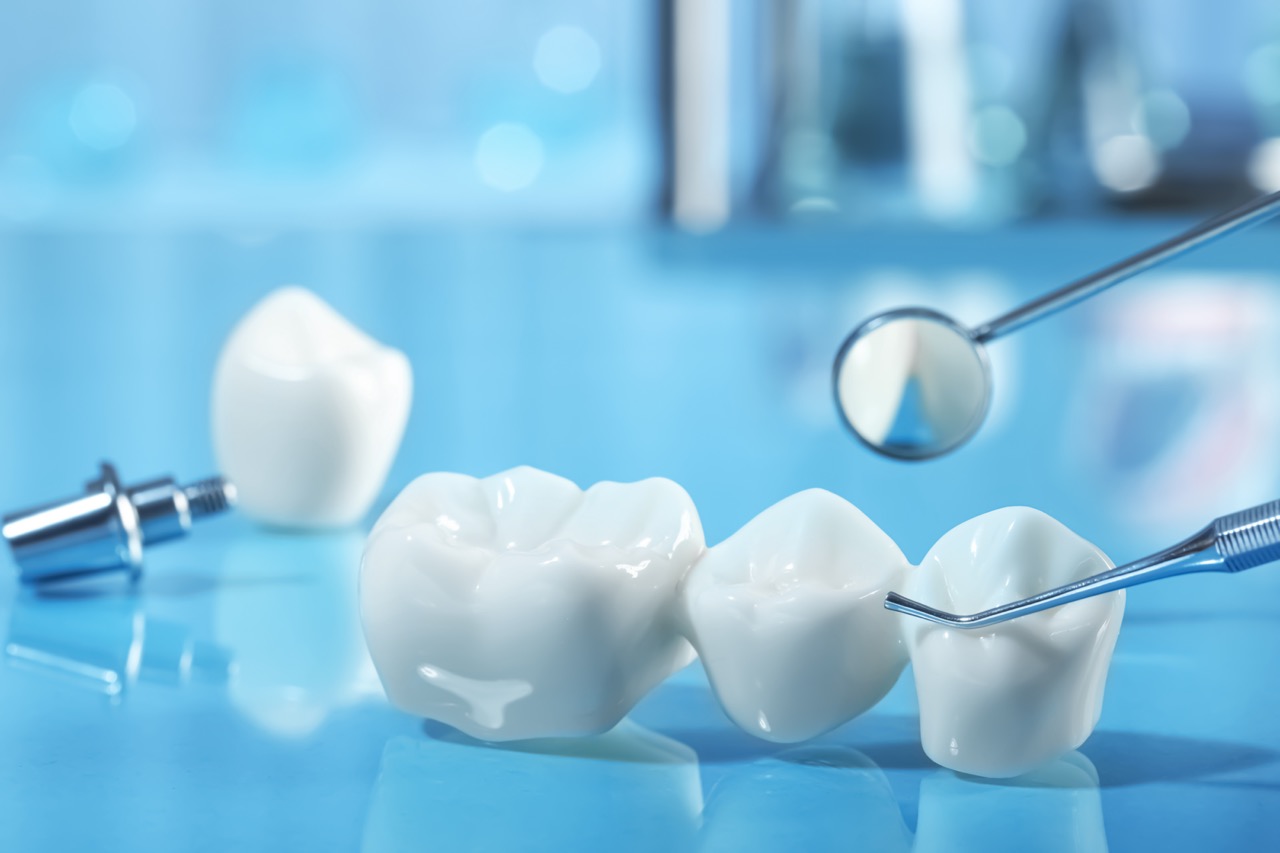
Choosing between a dental crown and a bridge can be confusing, especially when you want your smile to look natural and function properly. At Lumos Dental in Edmonton, we help you explore the options available for restoring your teeth and maintaining your oral health. Knowing the differences between a dental crown vs. bridge can guide you toward the right solution for your situation.
A single tooth that is damaged or weakened may benefit from a crown, which covers and protects it, while missing one or more teeth might be better addressed with a dental bridge. For patients who need a strong, fixed solution without relying on adjacent teeth, a dental bridge implant can provide lasting stability and support. In this guide, we walk you through how dental bridges and crowns work, the types of restorations available, and how to decide which option suits your smile so that you can take the next step toward dental restoration with confidence.
The Purpose of Dental Crowns and Bridges
Dental crowns and bridges serve different roles in restoring your smile and oral function. Knowing how each works can help you see which option may suit your dental needs.
What Is a Dental Crown?
A dental crown protects a weakened or damaged tooth. You might need a crown if a tooth has a large cavity, a crack, or has undergone a root canal. The crown acts like a cap that fits snugly over the tooth, giving it extra strength and stability.
Because crowns are precisely crafted to fit your tooth, you can bite and eat normally without experiencing any pain. Ceramic and porcelain crowns are designed to match the colour and texture of your neighbouring teeth, while metal crowns give back teeth that are subjected to more pressure and durability. Your dentist can restore your tooth’s appearance and functionality by installing a crown.
What Is a Dental Bridge?
A dental bridge helps in replacing one or more missing teeth. If you have a gap in your smile, a bridge fills it by attaching artificial teeth to the crowns on either side, or in some cases, to dental implants. This allows you to speak and chew in a more natural way, without putting extra strain on your remaining teeth.
Your bite and general dental alignment may be impacted by the shifting of your natural teeth, which bridges help prevent. They are made to look smooth and natural by blending in with your natural teeth in terms of size, shape, and colour. A dental bridge can replace lost teeth in a long-lasting and aesthetically pleasing way with the right maintenance.
At Lumos Dental, our team works with you to determine whether a crown, a bridge, or a combination of both from our dental bridges and crowns options will restore your smile effectively while supporting the health and alignment of your teeth.
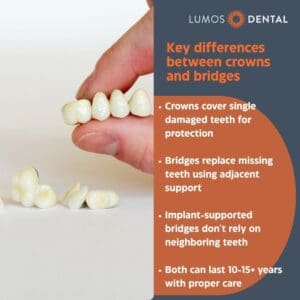
Dental Crown vs. Bridge – Key Differences
Choosing between a crown and a bridge can feel overwhelming at first, but knowing the differences in function, design, and treatment approach helps clarify which option fits your dental needs. This section breaks down these distinctions so you can see how each restoration works in real situations.
Purpose and Function
Crowns protect existing teeth; bridges replace missing teeth. Crowns are applied to a tooth that has been weakened by decay, cracks, or a large filling, giving it strength and stability for daily use. While bridges help in replacing one or more missing teeth entirely. By filling the gap, they restore chewing, speaking, and the overall appearance of your smile. Choosing between a crown and a bridge often comes down to whether you need to support a damaged tooth or replace teeth that are gone.
Structure and Design
Crowns cover a single tooth; bridges consist of multiple units. A crown acts like a cap, completely encasing a tooth to protect and reshape it. Bridges are more complex, with two anchor crowns on either side of the gap and one or more artificial teeth, called pontics, connecting them. This design allows the bridge to span the space left by missing teeth, providing stability and restoring your bite.
Treatment Approach
Crowns treat damaged teeth; bridges replace missing teeth. A crown is placed on a tooth that has been weakened by decay, trauma, or after a root canal to reinforce it and restore its function. Bridges rely on healthy neighbouring teeth or dental implants to support the replacement teeth, allowing you to regain full chewing function without leaving empty spaces.
At Lumos Dental, our team evaluates the condition of your teeth and guides you through the choice of dental crown vs. bridge based on your individual needs, restoring both function and the natural look of your smile.
When Do You Need a Dental Crown?
Dental crowns help in restoring the health and function of teeth that are damaged or weakened. They can give your smile a natural appearance while protecting the tooth from further problems.
Common Situations That Require a Crown
- Cracked, chipped, or worn teeth – Crowns can reinforce teeth that are physically damaged.
- Extensive decay – When a tooth has significant decay, a crown protects what remains.
- Large fillings – Teeth with large fillings may become weak and need additional support.
- After a root canal – Teeth often lose strength following a root canal, and crowns restore durability.
- Covering a dental implant – Crowns provide a natural-looking restoration over implants.
- Weak or broken teeth – Crowns allow you to bite and chew comfortably while preserving the tooth’s shape.
Materials Used for Dental Crowns
Crowns are made from porcelain, ceramic, metal alloys, or a combination. Porcelain and ceramic crowns are ideal for front teeth because they match the colour and translucency of your natural teeth. Metal crowns, on the other hand, are stronger and are usually recommended for molars, which handle the most pressure during chewing. Selecting the right material depends on the location of the tooth, the level of stress it will endure, and your personal preferences for appearance and durability.
When Is a Dental Bridge Better?
Dental bridges offer a practical solution for replacing missing teeth, especially when you want a restoration that feels natural and functions well. Choosing the right type of bridge depends on your dental health and how many teeth are missing.
Ideal Cases for Bridges
- Missing teeth in a row: Bridges work best when one or more teeth are absent consecutively.
- Support from neighbouring teeth: Strong adjacent teeth hold the bridge securely in place.
- Fixed alternative to dentures: Bridges provide a stable, long-term replacement instead of removable options.
- Restores chewing and biting: Filling gaps helps you eat comfortably and maintain proper function.
- Prevents teeth shifting: Bridges stop surrounding teeth from moving out of position.
- Maintains facial structure: Proper alignment supports the shape of your face and your overall bite.
- Blends function with appearance: Bridges offer a dependable solution for a natural-looking and functional smile.
Types of Dental Bridges
Traditional Bridge: Anchored by crowns on both sides of the missing tooth or teeth. This design works well when you have healthy teeth on each side to support the restoration.
Cantilever Bridge: Supported on only one side, used when there isn’t a natural tooth on the opposite side. It can replace a single missing tooth in specific cases.
Maryland Bridge: Uses metal or porcelain wings bonded to adjacent teeth. This type requires minimal alteration of healthy teeth and can be a conservative choice for replacing front teeth.
Implant-Supported Bridge: Fixed directly to dental implants for added stability and durability. These bridges do not depend on adjacent teeth, providing a strong, long-lasting solution for multiple missing teeth.
Comparing Cost, Longevity, and Maintenance
Understanding how long a dental crown or bridge can last, what care it requires, and the associated costs can help you plan for your dental treatment. This section breaks down these aspects so you know what to expect from your restoration.
Durability and Lifespan
Dental bridges and crowns can last 10–15 years or more. Their lifespan depends largely on the care you provide at home and the frequency of professional checkups. Brushing twice a day, flossing around the restoration, and attending regular dental appointments help keep crowns and bridges in good condition. Some patients may see their restorations last even longer with consistent care, while others may need replacement sooner if damage or decay develops.
Maintenance Tips
- Maintain daily oral hygiene by brushing and flossing around your crowns and bridges.
- Avoid biting hard objects, such as ice, hard candy, or using teeth to open packages, to prevent chips or cracks.
- Clean carefully around supporting teeth or implant anchors to prevent plaque and buildup that can affect the restoration.
- Schedule regular dental checkups so your dentist can examine for wear, cracks, or other potential issues.
Cost Considerations
Costs vary based on materials and complexity. Different materials, such as porcelain, ceramic, or metal, come with varying price points. The number of teeth involved, the type of bridge, and whether an implant is included also affect the total cost. At Lumos Dental, we follow the Alberta Dental Fee Guide and provide direct billing to insurance, so you can focus on your treatment without worrying about payment logistics.

Dental Bridge Implants – A Modern Alternative
Dental bridge implants offer a fixed replacement that does not rely on adjacent teeth. Unlike traditional bridges that use neighbouring teeth for support, implant-supported bridges attach directly to dental implants placed in your jawbone. This direct support gives the bridge extra stability and allows you to bite and chew with confidence.
Implant-supported bridges also help maintain the shape of your face by preserving the jawbone. Missing teeth often cause surrounding teeth to shift and can create a sunken appearance over time, but a bridge implant prevents these changes.
These bridges are well-suited for patients who want a long-lasting solution to replace multiple consecutive teeth. At Lumos Dental, we provide customized dental bridge implants designed to restore your smile, improve function, and maintain your oral health.
Choosing the Right Option for Your Smile
Selecting the right dental restoration can feel overwhelming with so many options available. Your smile and oral health are unique, so a careful evaluation helps identify the treatment that fits your situation best.
A personalized consultation determines the best solution. A dentist will examine your teeth, gums, and jawbone to see which option will restore your smile most effectively. They consider the strength and position of surrounding teeth, the condition of any damaged teeth, and your overall oral health. This assessment helps determine whether a dental crown or a bridge will provide lasting results and support proper function.
Lumos Dental provides restorative solutions that are natural-looking, functional, and designed to last. At our clinic, we focus on treatments that blend seamlessly with your natural teeth. Each plan is tailored to your needs, whether you require a single crown, a bridge to replace missing teeth, or a dental bridge implant for added stability. Our goal is to restore both the appearance and performance of your smile, so you feel confident every time you chew or speak.
Schedule a Consultation with Lumos Dental
Take the first step toward a healthy, complete smile. At Lumos Dental, we provide expert care for dental bridges and crowns, as well as dental bridge implants, in Edmonton, AB. Lumos Dental serves Edmonton, AB T6C 0Z8, and our team will evaluate your needs to guide you toward the treatment that best restores your smile.
Call us today at (780) 433-0222 or visit our Contact Page and schedule your consultation. Let us help you restore both the function and appearance of your teeth with personalized care you can trust.

Dr. Taka Shah graduated from the University of Alberta Dentistry program in 2011 and is the owner of Lumos Dental in Edmonton, Alberta. He is passionate about lifelong learning and has pursued extensive postgraduate training to enhance his skills and knowledge. His clinical expertise includes sedation dentistry and advanced Invisalign techniques, supported by his active membership in the American Academy of Clear Aligners. Dr. Shah is dedicated to providing high-quality dental care and helping his patients achieve healthy, confident smiles.